

UDOT Environmental Impact Statement (EIS) Little Cottonwood Canyon
Join us to stop the ill-conceived Gondola to be built in Little Cottonwood Canyon. Help preserve this world-class natural beauty and Protect Our Alta!
Help Us Fight The Gondola!
Litigation can be costly, and every donation makes a meaningful difference. Your support helps us cover the costs of our lawsuit while also funding our lobbying efforts to educate and inform lawmakers about the issues that matter. Every contribution, no matter the amount, helps us continue this important work.
Little Cottonwood Update
In an encouraging development, UDOT has announced a $250 million plan to begin implementing steps outlined in Phase 1 of UDOT’s three phased transportation project selecting a gondola as its preferred alternative, to reduce winter roadway congestion in Little Cottonwood Canyon.
Over the past two years, UDOT repeatedly stated it would not move forward on phase 1 due to ongoing litigation over the environmental analysis prevented any action until that litigation was resolved.
The newly announced plan outlined by UDOT, seeks to add approximately 30 new buses over the next two winters, in hopes of increasing bus frequency to Snowbird and Alta from every 30 minutes to every 20 or possibly every 10 minutes. This plan will also include infrastructure additions, including two indoor facility stations at Snowbird and Alta Ski Area, plus would build a parking lot and mobility hub currently planned for the mouth of Big Cottonwood Canyon.
Variable tolling would also to be implemented, while roadside parking would be barred near the resorts in an effort to improve traffic flow.
Much of this is welcome news and should be applauded. Friends of Alta has long supported implementing the common-sense solutions outlined in phase one of UDOT’s three phase approach, as many are scalable, environmentally conscious, cost effective, and can help ease canyon congestion beginning next winter as opposed to years down the road. It is still unclear that bus stations, akin to train stations in the valley are needed, environmentally appropriate, scaled and sited appropriately. We are hopeful that further analysis as part of approvals and permits will make even these infrastructures rational, reasonable, environmentally and economically appropriate for winter visitors during the ski/board season.
If implemented correctly, reduction to canyon congestion could be significant.
This is an encouraging development for those of us who champion commonsense solutions to canyon congestion, and Friends of Alta will be monitoring the implementation and impact of this plan closely.
While this news is encouraging, the shadow of a potential 8-mile-long environmental “tragedy” still looms large over Little Cottonwood Canyon. As long as the gondola remains the endgame for UDOT, Friends of Alta will Continue to oppose it.
Why we are against the gondola
Environmental Impact
-
Little Cottonwood Canyon is home to an essential watershed that provides local cities, like Sandy and Salt Lake City, with a large percentage of their culinary drinking water. The construction of the world’s longest gondola, over 8 miles long, consisting of 20 towers and 2 angle stations, puts that vital water at serious risk of contamination.
-
The risk of contamination is so high that Salt Lake City, Sandy City and their joint Metropolitan Water District of Salt Lake City and Sandy filed a lawsuit against UDOT, arguing that environmental analysis done for the gondola option were insufficient to safeguard the drinking water supply.
-
Little Cottonwood Canyon’s soil contains contaminants from extensive mining activity in the1800s, including lead and arsenic. These contaminants would likely be disturbed by the construction of a gondola, which would involve digging, blasting, and land disruption, putting an enormous amount of drinking water at risk for residents and businesses. This contamination could last for decades.
-
The gondola would not solve congestion in Little Cottonwood Canyon, and it was never designed to. According to UDOT’s own EIS, if a gondola were constructed, cars visiting Alta and Snowbird would remain the same, while skier visits would increase by roughly 20%. The gondola is designed to increase visitation to two private ski resorts and would greatly increase the environmental pressures on the canyon and diminish the user experience from overcrowding.
-
The impact on the viewscape from 200+ foot towers, and bus sized cable cars stretching eight miles through the heart of Little Cottonwood Canyon would be permanent and pervasive.
The Cost for Utah Taxpayers
-
The most current estimate for the phased gondola project is $1.4 billion (up from the initial estimated cost of $550 million) and will be paid for by Utah tax payers to the tune of roughly $1,000 per household. Only 10% of Utahans downhill ski yearly on average, which leaves 9 out of 10 Utah taxpayers footing the outlandish bill while receiving no benefit. In fact, the majority of skiers accessing Alta and Snowbird come from out of state, making this a $1,000 tax placed on every household in Utah that disproportionately benefits affluent tourists, and two thriving, private businesses.
-
In reality, most Utahans will never ski Alta or Snowbird, but they all see the crumbling infrastructure throughout the state and the needs of the communities they call home. Building the gondola would divert transportation funding away from higher priority transportation projects in Utah, ignoring the needs of the people statewide. It’s morally and ethically unjustifiable.
-
Common sense solutions are a fraction of the cost, scalable, and effective. UDOT did not consider and test these less expensive alternatives before allocating additional taxpayer dollars and greenlighting the Gondola.
Inconsistent Approaches from UDOT
As it has done with Little Cottonwood Canyon, UDOT is considering an approach to alleviate congestion in neighboring Big Cottonwood Canyon. The difference in solutions, however, is jarring. UDOT believes that congestion in Big Cottonwood Canyon can be righted by an enhanced bus service, enclosed bus stops at the resorts, minor road improvements to help the bus system, and a winter-season tolling system starting below Solitude Entry 1 with variable pricing. The estimated expenditure to address the congestion issues in Big Cottonwood Canyon is about $90 million.
A Deeply Unpopular Solution
It is no secret that the gondola is not a popular solution to congestion in Little Cottonwood Canyon. We know from the record-breaking 50,000 comments sent to the Utah Department of Transportation (UDOT) during the public comment period that citizens are overwhelmingly opposed to the construction of a gondola in Little Cottonwood Canyon. Roughly 8 out of 10 Utahans who submitted comments opposed the construction of a gondola.
Elected officials of impacted cities also oppose the gondola, with Mayor Jenny Wilson, Mayor Erin Mendenhall, Mayor Monica Zoltanski, and Mayor Roger Bourke all on the record opposing its construction. As mentioned above, both Salt Lake City and Sandy also filed lawsuits to prevent the gondola’s construction.
The Gondola Only Serves Two Private Ski Resorts
The Gondola will only stop at Snowbird and Alta, serving only those who paid to access a private ski area. This ignores the growing population of hikers, mountain bikers, backcountry skiers, photographers, and other canyon visitors. Depending on cost-feasibility and adoption, it may not run in the summer at all.
Commonsense Solutions We Support
Friends of Alta continues to support common sense, scalable, solutions that can be implemented quickly, at a significantly lower cost. These include:
Restoring historic UTA routes- This past winter, UTA only ran 23 buses a day up the canyon, a stark contrast to its peak when 87 buses would run daily. It’s hard to believe that tourists once had the convenience of flying into Salt Lake City International Airport and taking public transit straight to the ski resorts—no need to rent a car at all.
As demand increases, it is imperative that we enhance our transit services by increasing the number of buses and implementing express routes to both Alta and Snowbird. This will not only elevate ridership levels but also streamline the transit experience by minimizing stops at each resort’s parking areas. The result will be a more seamless and efficient journey for passengers. Additionally, investing in new electric buses during peak demand periods will significantly improve air quality and promote sustainable transportation practices.
Enforce the Existing Traction Laws/Pass a New Traction Law- Legislation should mandate that all vehicles on mountainous highways from November to April either have traction devices readily available or installed. This requirement ensures that when severe winter weather strikes, even unexpectedly, vehicles are properly equipped to handle tough driving conditions. This could help prevent dangerous situations and reduce congestion in the canyons. Additionally, issuing pre-approved stickers for vehicles that meet these criteria streamline enforcement and minimizes traffic delays.
Incentivize Carpooling- To encourage carpooling, incentivize vehicles carrying multiple passengers. Such incentives may include designated parking spaces, priority reservations, and reductions in toll and parking fees.
Prevent Unsafe U-turns: U-turns from roadside parking areas should be prohibited to enhance safety and facilitate smoother traffic flow. Drivers who park along the road should continue uphill until they can turn into a designated parking area before making their way downhill. Installing median devices may be essential to promote this traffic pattern. To ensure compliance, clear signage should be put up, and officers should be present to enforce these regulations.
Improve Merging: To enhance traffic flow and safety at ski resorts, it’s essential to manage the vehicles leaving parking lots onto SR210. This will help alleviate congestion on SR210 above the parking lot as traffic ascends the canyon. Installing a traffic light could effectively regulate the movement of cars during peak hours when many vehicles exit from the top of the canyon.
Build Up-Canyon Snowplow Parking: Create new parking spaces up-canyon for UDOT snowplows. This change would allow them to begin snow removal more quickly, rather than having to travel from the valley to the canyon.
Augment with Private Shuttle: By partnering with private operators to provide shuttles and drivers specifically during high-demand days—approximately 30 to 40 days each year—UTA can effectively minimize its fleet size, which in turn reduces bus maintenance expenses. Additionally, utilizing smaller 14-seat shuttles can further cut costs while enhancing the quality of service.
Implement Permit Parking Programs: Implementing reserved permit parking during peak hours helps ensure available parking spaces and decreases roadway congestion, a trend observed at three out of the four Cottonwood Canyon resorts utilizing this system. It would be beneficial for Snowbird to adopt a similar permit and reservation approach during busy periods.
Stagger Operating Hours for Ski Resorts: Currently, Alta and Snowbird Ski Resorts operate on similar schedules, which leads to congestion during peak arrival and departure times for skiers. To alleviate this issue, the resorts might explore the option of staggering their hours. For instance, Alta could consider opening earlier at 8 AM and closing at 4 PM, while Snowbird could open at 9 AM and close at 5 PM. This adjustment could help to smooth out the flow of visitors.
Incentivize High Occupancy Vehicles (HOV): HOVs with a minimum of eight passengers could receive incentives by being granted priority access to the highway during specific peak periods or hours.
Do you want Alta to look like this ?
Why the Gondola is not right for LCC
Prohibitive Cost
-
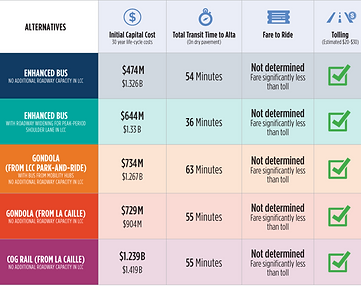
Cost of Gondola is between $729 Million (UDOT ROD) and $1.4 billion. This will be paid for by taxpayers of Utah. The estimated cost is $1,000 per household.
-
Cost of Enhanced Bus is $644 Million ( UDOT ROD).
-
Snowshed's cost $109 Million (UDOT ROD). Snowsheds would still have 11 hours per year of canyon closure compared to the current 56 hours.
-
Cost to Ride the gondola:
-
We have no estimated cost to ride the gondola provided by UDOT. As such, we have to estimate the cost. Alta's Mayor Sondak estimated the cost to ride would be $111 per person.
-
The cost for tolling is estimated to be between $25 to $30 according to Josh Van Jura UDOT EIS Project Manager (quote found here).
-
The cost to take the ski bus now is $5 one way trip ($10 roundtrip) to get to the ski resort. If you have a season pass to the ski resort, super pass, or Ikon pass your fare is free.
-
Recreational Access
-
Gondola only stops at Snowbird and Alta. It would serve only those who paid to access a private ski area, but leave behind the growing population of hikers, mountain bikers, backcountry skiers, photographers, and other canyon visitors. And depending on cost-feasibility and adoption, it may not run in the summer at all.
-
Little Cottonwood Canyon is home to world-class backcountry terrain with unparalleled access that attracts tourists, businesses, and new residents. The map to the right provides a ballpark idea of the 35 named backcountry ski runs, although there are many more unnamed backcountry runs that will be impacted by the gondola.
-
Threatens the historic significance of the Lower LCC Climbing Area Historic District. This is a locally and nationally recognized site of early recreational climbing and bouldering that will be irreparably damaged. Decades of climbers have and continue to experience the solace, connectivity, and community of this historic district, which has been determined eligible for listing on the National Register of Historic Places by UDOT and is currently in the process of nomination.

Image Provided by Wasatch Backcountry Alliance. Click image to enlarge photo.

Image provided by Save our Canyons
Viewshed Impact
-
Snowbird's tallest tower is 140 ft. The gondola towers range from 130 ft to 262 ft.
-
For comparison, electrical transmission towers are 120 feet tall, which is shorter than the shortest gondola tower.
-
-
There will be 22 towers up the canyon.
Do you want to see this up the canyon?
Friends of Alta supports common sense solutions to improve canyon traffic, including parking management technologies and policies, carpooling incentives, traction device requirements and enforcement, and the development of regional transportation hubs to promote enhanced busing. These common sense measures meet the goal set out by UDOT to minimize potential harm to the watershed while maintaining the infrastructure to service the whole canyon. This option is flexible and can be changed to meet changing needs for transportation in LCC.
Talking Points / FAQ
Below are some talking points and FAQ's related to the gondola.
 |  |  |  |
|---|---|---|---|
 |  |  |  |
 |  |  |  |
How are we pushing back?
FOA and our alliance have pushed back every step of the way, focusing on a two prong strategy: public outreach and lawsuit. On December 4, 2023, we filed a lawsuit. Before that, we have organized our members to attend townhall meetings, broadcasted on media, written letters to UDOT.
Three Lawsuits Filing
Friends of Alta filed its 95-page lawsuit on December 4, 2023. Salt Lake City, Sandy, and Metro Water District filed a different lawsuit against UDOT on December 11, with different causes of action, mostly focused on governmental statutes and regulations. Save Our Canyons filed a third lawsuit on December 18, 2023. Each complaint has significant overlap, but each plaintiff wanted their own counsel. On April 17, 2024 all three lawsuits were consolidated to be reviewed by Judge Campbell. This consolidation will be quite helpful, and possibly save everyone on the plaintiff's side money.
These lawsuits challenge various aspects of UDOT’s review and selection process. The lawsuits allege that UDOT failed to properly justify the gondola’s impacts and costs, consider reasonable alternatives, and provide unbiased analyses. Additionally, they claim UDOT inadequately assessed environmental impacts and failed to respond substantively to public comments, coordinate effectively with the United States Forest Service, and comply with the 1966 Transportation Act, which safeguards public recreation areas, trails, and local climbing areas
Read the three lawsuit filings against the gondola below.
Lawsuit Timeline
Are we fighting a losing battle?
No! The Gondola won’t be constructed until phase 3 and only phase 1 has been funded. Remember that this plan is highly unpopular.
Whose against this plan?
Not surprising, this plan that primarily benefit the two ski resorts are deeply unpopular.
-
Our coalition members: Friends of Little Cottonwood Canyon (FOLCC), Save Our Canyon (SOC), Wasatch Backcountry Alliance (WBA), Canyon Guard (CG), Student for the Wasatch, Salt Lake Climbers Alliance (SLCA), Save Not Pave (SNP), Black Diamond, Patagonia, and more recreational companies. See below for their links for more information
-
Elected officials: Town of Alta voted against it, Town of Cottonwood Heights, Salt Lake City, Sandy City, Salt Lake County
-
Public opinion: 80% of residents are opposed, listen to public hearing on 2020, 2021
Understand The Phased Approach:
To better understand the fight ahead, it’s important to understand what the “phased approach” of Gondola Alternative B will look like.
If handled correctly, there is a high likelihood that Phase 1 alone could meet the reduction in traffic congestion sought by UDOT. It could do so in an equitable, environmentally conscious way, that is both scalable and adaptable to meet any challenges that may arise. Currently, only Phase 1 has secured funding. Friends of Alta will monitor the data and outcomes produced by Phase 1 as this information will be vital in determining the effectiveness of the commonsense solutions put forth.
How You Can Help
While Friends of Alta will take every measure to consolidate and reduce costs, the reality is that this lawsuit will be extremely costly. We are a small non-profit going up against well-funded opposition and we need your help to level the playing field. We have the best Members in the world, and we humbly ask you to donate to support our ongoing efforts to protect Alta and Little Cottonwood Canyon from from this undue and unnecessary threat.
This is a fight that Alta and Little Cottonwood cannot afford to lose. Please help us protect Alta and Little Cottonwood Canyon for generations to come.
Donate Today
PLEASE NOTE:
In the summary section you will see "donation" with a set $75 donation in it.
***You may put in any desired amount.***
By selecting "Other".
Zeffy does not charge transaction fees, so your entire donation goes directly to FOA! You can add a contribution to help Zeffy keep running its services. If you don't want to add a contribution, in the summary section, choose 'Other' in the drop-down menu and then enter $0.
Other Ways To Donate
Mail Checks to
Friends of Alta
PO Box 8126
Alta, UT 84092
Put "Gondola" in Memo
@friendsofalta
Please put "Gondola" in description
Please select "gondola lawsuit" under campaign
Friends of Alta is a non-profit 501(c)(3) corporation, your contribution is tax-deductible to the fullest extent allowed by law. Our IRS Federal EIN is 94-2856217. Please consult your tax professional for advice.
 |  |  |  |
|---|---|---|---|
 |  |  |  |
 |  |  |  |
Educational Videos
Learn more about the gondola through these educational videos.
Peak Pressure
New documentary “Peak Pressure” explores Little Cottonwood Canyon’s traffic issues of Little Cottonwood Canyon through a more neutral viewpoint.
Video created by University of Utah Students
Gondola is Wrong for Little Cottonwood Canyon
Learn more about why the gondola is wrong for Little Cottonwood Canyon
Video created by Friends of Little Cottonwood Canyon
Save Little Cottonwood Canyon: Backyard Boulder Problems
Little Cottonwood Canyon attracts climbing talent from all over the world. Not only has it become a nationally-recognized climbing mecca, but also it has cultivated a tight-knit local climbing community. This film takes an inside look into two climbers’ experiences climbing in LCC and how the climbing community would be affected by UDOT’s alternatives.
Video created by Students For The Wasatch
Home Crag / Gnarly Nutrition
Gnarly Nutrition's “Home Crag,” filmed and edited by Headlamp Studios, features rock climber and Olympic medalist Nathaniel Coleman, Salt Lake Climber Alliance's Executive Director Julia Geisler and USA Climbing's CEO Marc Norman.“Home Crag” illuminates the three unified perspectives on why the rock climbing in LCC deserves protection, and illustrates why the canyon is like none other.
Video created by Gnarly Nutrition's “Home Crag,” filmed and edited by Headlamp Studios
Media Coverage
KUTV Fresh Living
Background Information on The Gondola Project:
Learn More
See what other organizations are saying about the gondola for Little Cottonwood Canyon.
 www.canyonguard.org |  www.lccfriends.org |  www.saltlakeclimbers.org |
|---|---|---|
 www.saveourcanyons.org |  www.savenotpave.org |  www.studentsforthewasatch.org |
 www.wasatchbackcountryalliance.org |  |  |
 |
Merchandise
Show your support for a gondola free canyon and join us in supporting our lawsuit through one of these merchandise options!

Alta and Little Cottonwood Canyon: Jewel of the Wasatch
$100.00
Please note that Black Diamond distributes this book so you will be directed to their site to complete the purchase. 100% of sales go back to Friends of Alta.
"Only capturing pure beauty seems hedonistic and socially irresponsible. It is important to document what we are trying to save as well as what we are destroying at a fast pace.” Howie Garber
"Combining imagery and writing from geologists to former mayors, from economists to ski guides, and from later-in-life transplants to multi-generation Utahns, Garber has curated a compendium of eloquent Wasatch voices that highlight the beauty and wildness of this place." Mary McIntyre


